

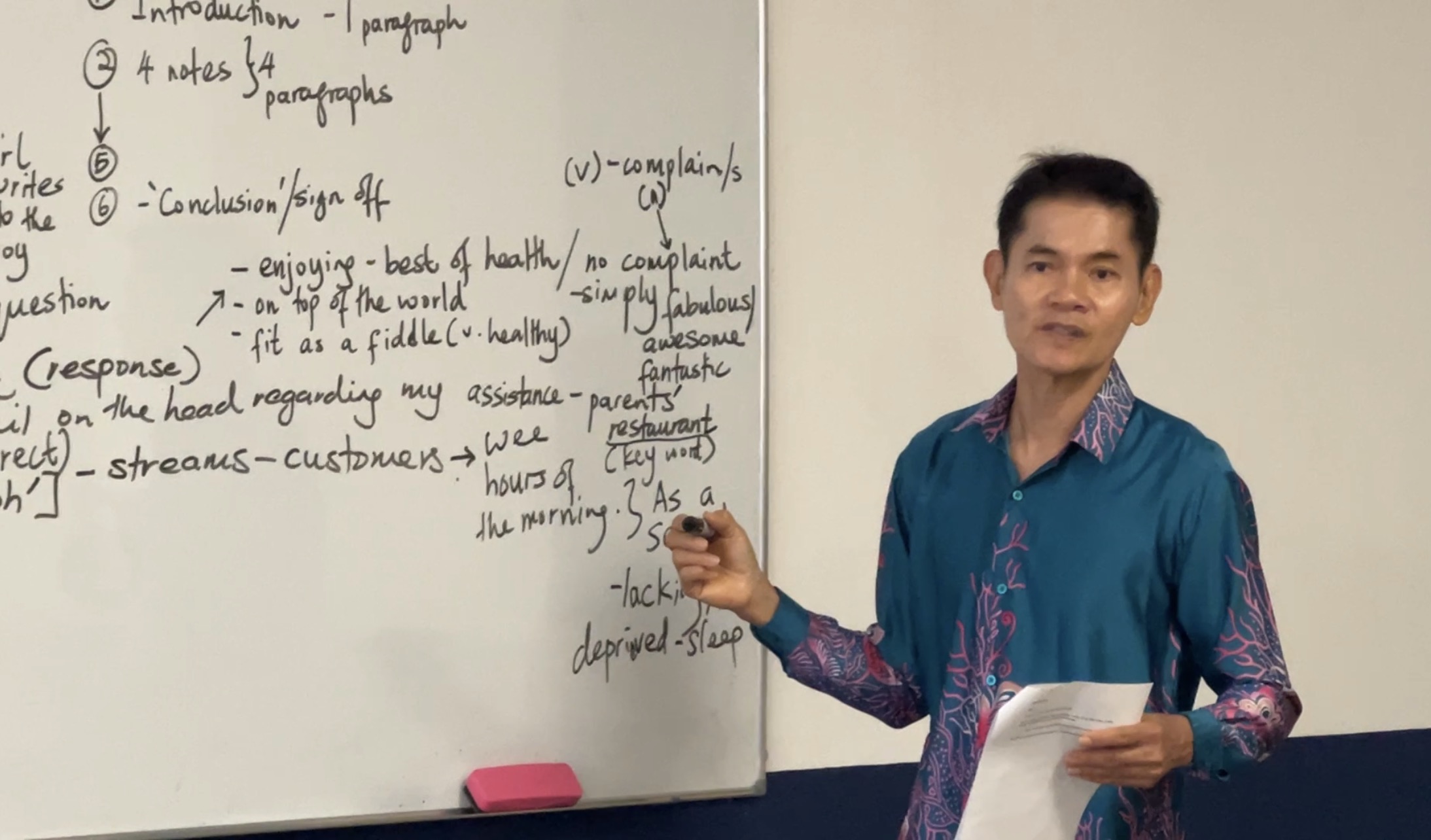
 One day in class, Augustine Law, a part-time Malaysian University English Test (MUET) lecturer at Methodist Pilley Institute (MPI), posed a question to his students: “If there were only five seats available for a Degree in Nursing programme and five of you were competing for it. You all graduated with a CGPA of 4.00 – but only one scored a Band 5 in MUET. Who do you think will have the upper hand?”
It is without question that it was the candidate with Band 5. Augustine had demonstrated the importance of MUET. It goes beyond being a prerequisite to enter local universities or even to graduate.
Augustine was trained in the Teaching of English as a Second Language (TESL). He taught MUET and the SPM 1119 English paper for 38 years and was among the pioneer group that was tasked to teach MUET when it was introduced in 1999.
Being involved in it for so long, he witnessed the evolution of MUET ensuring the students are prepared for the academic and social demands of college and university. To date, MUET has undergone two major revisions in 2008 and 2021 to align with international benchmarks to better prepare students for university and workplace demands.
According to him, MUET was introduced because the government realised that there was no paper to gauge the eligibility of the candidates for university studies. This means that prior to MUET, tertiary institutes did not take students’ English performance into consideration.
Because of that, many students found it difficult to cope with their studies at the university level – they couldn’t write proper sentences in English and had a hard time reading reference books as they were all in English.
“With MUET, there is a fixation; like you need at least a Band 3.0 to enter. For certain programmes, there is a different requirement to be able to graduate.
“For example, for Law, the lowest requirement to graduate is Band 4.0; for medicine, it is Band 5. If you want to become an English teacher, you need Band 5.0 to graduate.
“I had a student who called me in tears because all his course mates were graduating already and he could not because he could not secure a Band 5 in his MUET. He sat for many MUET exam sessions yet he could only achieve Band 4,” he said.
You may ask ‘Why is it difficult?’ While MUET tests four language skills – Speaking, Reading, Listening and Writing, it is not about the language alone. It is about idea organisation, communication, critical thinking, and academic readiness.
While it started out and was treated as just another English paper in the beginning, today MUET has evolved and is now fully aligned with the Common European Framework of Reference for Languages (CEFR) levels. It is the same standard adopted by the International English Language Testing System (IELTS).
CEFR uses a ‘can-do’ approach as its guiding principle, focusing on what learners can actually do with the language in real life. With this approach, he explained that the examiners are looking for the ability to construct complex sentences.
That is why, he said knowing the marking scheme becomes very important. Augustine explained that if the candidates could come up with a few simple sentences, they would be at A2 in IELTS (Band 3.0 – 3.5), which is also equivalent to Band 1.0 to Band 2.5 in MUET.
“If they see a candidate who is able to make phrases combined with clauses and proper ideas, strung together in a complex structure, immediately the candidate will be put in Band 4 and above already,” he said.
This is where MPI’s Intensive MUET English Programme becomes beneficial for students.
It is an exposure programme for those who want to build up their foundation. This is especially for those who are weaker and wish to get at least Band 3.
However, through this class, it is also aimed at helping these students to get at least Band 4. The higher the band, the better opportunity for these students to excel not just in their studies but in their careers.
The good ones, he said, may enrol in the class to ensure that they could get to Band 5.
Augustine is using the scaffolding teaching method – helping the students to master the skill, ensuring that students can apply it when it comes to the exam.
“I target the thesis statement. The thesis statement is in the first paragraph for academic writing. You must have your three main points stated clearly. For example, if the topic is debatable.
“The most important criterion a mother must have is love. Discuss. So, in this kind of intangible situation, they can only think my mother would take care of me, my mother cooks for me. You must come up with the summary of all these things that your mother does to reflect love.
“So, I slowly guide them, oh, being responsible, that is showing love. Summarise and come up with either one word or maybe a couple of words and put it in the first paragraph. The most important aspects of a mother’s love are these: this, this and this,” he said, adding that there are proper guidelines.
He said he will always start with basic drills, sentence structure and their own thesis statement before moving on to writing, discussions, examples, linking sentences, and cohesive devices.
He described this as very painful baby steps; making sure students, especially weaker ones pass with a Band 3.
“The exposure is very important. I also concentrate on exam format. My practices are from ever-ready market books and then I will move on to exam questions,” he said.
He said if the students could get familiar with the exam format through past-year papers, half the battle is won. Then, the next half is the proper guidance from qualified instructors.
Without proper guidance, students would not know what is necessary. Then, they would develop this ‘bad habit’ – doing it without structure and no one is there to give feedback.
Through the collaboration between the students and qualified instructors, not only does it help the weaker students to cope with the papers, it also helps good students. In fact, if good students attend a few sessions, he is confident that they could score up to Band 5 easily.
“You see in the Intensive MUET programme, we cover a lot of things. I will not start with the past year papers; past year papers drill is towards the end already. What we do is we split the skills. I drill the students with a different approach; one paragraph at a time, making sure all are properly presented.
“You cannot simply plunge and do it. Students will receive feedback to stop them from their bad habits,” he said.
He also explained that generally, weak students come from a lack of exposure where English is not their mother tongue and they hardly use English in their everyday conversations.
Without much exposure, ideas remain in their heads and they lack the ability to express them.
What the Intensive MUET programme is doing, he said, is trying to help these students to pull themselves up and to improve through giving them the exposure. Not only that, he also encouraged the students to read; an important habit towards improving their English level and to understand what is happening globally.
He said this knowledge is important to enable them to answer the questions as any ideas they present must also be supported with evidence. He said knowledge is the most crucial part in the writing and speaking papers.
“With MPI helping you, there should be nothing to hold you back and in fact English is actually the answer to all those dreams you have in the future.
“MUET is like a ticket; it is like entering a cinema, you tell the usher, I have the money to pay you, but you don’t have the ticket and the ticket counter is closed, the ushers cannot accept you. So make full use of it, take full advantage of it and do not hold back,” he said.